For the first time, I am teaching the dual credit senior English class at my school. It’s been a fun challenge for me, and every day I learn something new.
In teaching this course, I inherited the textbook Rereading America, which is not like any other textbook I’ve ever used. Each section of the book focuses on an American cultural myth. Right now, my students are reading about myths of gender alongside Macbeth. Other sections focus on myths of education and empowerment, technological progress, family harmony, race, and individual opportunity.
The newest edition of the book, which my school does not have, starts with a section about myths that explore fairness and equity. As I’ve been reviewing the newest edition, I’ve also kept an eye and ear on current events. As a result, my understanding of these concepts is in a state of flux. On one hand, that says a lot about my own privilege in that I’ve not doubted the American system enough; on the other hand, it also says that we’re living in a time when how we understand and access fairness is changing and evolving.
With all this rattling around in my mind, I wanted to put together a collection of texts to help students also consider the meaning of justice.

This post may contain affiliate links. Please read the Terms of Use.
Poetry Recommendations
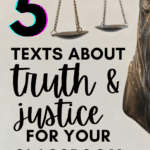
As an idea, “justice” comes with several symbolic meanings. Many court buildings feature the familiar statue of Lady Justice carrying the sword and scales and, oftentimes, wearing a blindfold.
However, in the poems “Mercy” and “Allowables” Rudy Francisco and Nikki Giovanni, respectively, the central symbol is a spider. In both cases, the speakers mention the instinct to smash or squash the spider even though it’s not a threat. While a spider may not be pretty, needless killing isn’t justice. Taken on a larger stage, the spider becomes symbolic of groups who suffer oppression, discrimination, and violence because of how they look, talk, or pray. Especially in Francisco’s poem, there’s also the question of how mercy and justice relate to one another. All my resources for these poems are here.
In Francisco and Giovanni’s poems, justice gets conflated with fear. In “A Poison Tree” by William Butler Yeats, it conflicts with vengeance. Popular media portrays vigilantes that take justice into their own hands as heroic. Yeats challenges or complicates this idea, suggesting that vengeance is not justice. The results of the speaker’s actions are their own kind of karma though. Read it here.
Longer Works
Few courts loom over American literature like Judge Danforth’s courtroom in The Crucible. While the Salem Witch Trials seem long ago, the political allegory in Arthur Miller’s drama maintains its power. While the court attempts to seek and define righteousness, Miller shows the audience that human weakness complicates truth. When the pursuit of justice conflicts with personal accountability, integrity is often the victim. Literature, like The Crucible, allows readers to explore these concepts in the relative safety of fiction. My favorite resources for teaching The Crucible are here.
Like Judge Danforth, Atticus Finch is a key figure in the American legal imagination. While Arthur Miller sidelines innocence in favor of discussing hypocrisy and hysteria, innocence is front-and-center in Harper Lee’s To Kill a Mockingbird. Since the trial in To Kill a Mockingbird is imperfect, I often pair this text with excerpts from Just Mercy by Bryan Stevenson, a nonfiction account of real-life figures grappling with injustice. Stevenson’s experience as a Black lawyer in the south (and as founder of the Equal Justice Initiative) helps provide a counter to Lee’s perspective.