Recently, I shared what trends in education have been inspiring me lately. I drew from a variety of subjects close to my English teacher heart: grammar; instructional design; literature; and, of course, Taylor Swift.
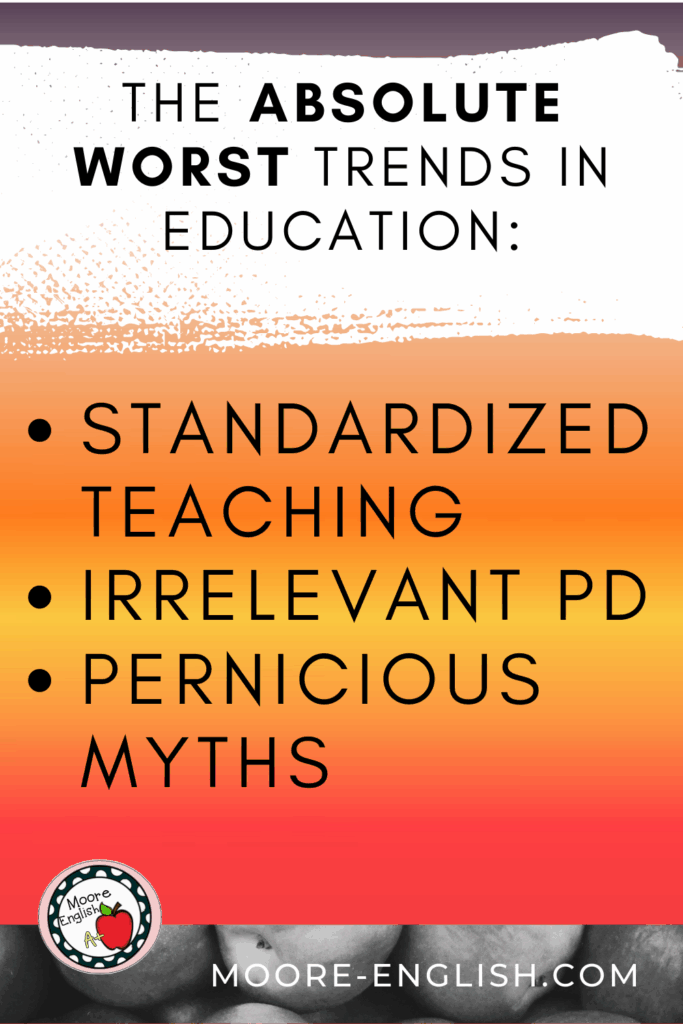
However, as I was revisiting recent sources of inspiration, I was also reminded of the trends in education that do not inspire me. These are the trends in education that lead to burnout, frustration, and exhaustion. Here are the worst of the worst and some strategies to combat them.

This post may contain affiliate links. Please read the Terms of Use.
Trends in Education by the Numbers
It can be difficult to find inspiration in teaching right now. Let’s check out the numbers that show the ugliest trends in education.
According to EdWeek,
- 49% of teachers felt their morale has decreased in the past year;
- teachers estimate that they work an average of 57 hours per week;
- Black and Hispanic teachers report working even more (between 64-65 hours a week).
According to Pew Research Center,
- 48% say the academic performance of most students at their school is fair or poor.
- 49% say the behavior of most students at their school is fair or poor
- 77% of teachers say their job is frequently stressful.
- 70% of teachers say their school is understaffed.
- 68% of teachers say it’s overwhelming.
Both of these articles stem from extensive data collection efforts, and I cannot do justice to the full scope of their research. Please check out both articles for a better understanding of the challenges facing teachers and these dangerous trends in education.
Standardized Teaching
I’ve previously written about standardized testing, so we’re not going to rehash that terrain. However, I do think it’s worth pointing out that standardized testing can lead to another educational evil: standardized instruction.
Few things infuriate me like standardized instruction: the pedagogical (or political) belief that teachers in one grade level or content area should all be teaching the same content, in the same way, at the same pace.
While sharing curricular and assessment resources is valuable, the idea that each classroom and instructional strategy should be identical frames education as an assembly line. Collaboration is an essential instructional resource; conformity it not.
Many students may respond to common or shared instructional strategies, but the makeup of each class is unique. Even if a teacher uses the same resource with two classes, her approach to that resource will vary based on the needs of each classroom. This is why standardized teaching is one of the worst trends in education.
Similarly, the texts a teacher chooses will also speak to the needs of the curriculum, yes, but requiring all teachers in a content or grade level team to use the same texts underestimates the power of selecting texts based on student needs and interests. Sometimes teachers also make text changes based on what will be triggering for students and what plays to their instructional strengths.
When I struggle with a topic like standardized teaching, I look for solutions. Here are some of my favorites:
- Abridging and Modifying Texts
- 14 Texts for Reluctant Readers
- 4 Favorite Differentiation Strategies
- If you want to read more about the danger of “one-size-fits-all” instruction, check our this article from Michael D. Smith at the MIT Press Reader. Smith focuses mostly on higher education, but the principles apply to K-12 education.
Irrelevant Professional Development
Professional development is a tricky bailiwick in education. On one hand, PD can be valuable and insightful; plus, most states require teachers to attend a certain number of PD hours to maintain their certification.
On the other hand, teachers can be resentful of PD that is chosen for rather than by them, is led by non-teachers, is redundant, is demeaning, is belittling, is unengaging, or is otherwise irrelevant. We’ve all be there. Teachers can spot bogus PD from a mile away.
As with students, teachers benefit from meaningful, personalized PD. Edweek indicates that 52% of teachers found that PD from the past year was irrelevant. 48% of teachers feel they are required to attend too much PD. Plus, teachers are more likely to indicate PD needs in technology and digital tools while their administrators are more likely to indicate that teachers need PD in classroom management or coaching. It’s clear that there’s a disconnect between teachers and admin about dangerous trends in education.
To make sure that PD is relevant and meaningful, check out these resources for combatting worrying PD trends in education:
Pernicious Myths Become Trends in Education
In college, I read Discourse and the Construction of Society by Bruce Lincoln. More than any other text, Lincoln’s work helped me understand the force of narrative and how it shapes our understanding of the world. Lincoln couches powerful narratives in “myths” that evoke sentiments of affinity and estrangement. These emotional responses help explain why sometimes disproven theories continue to appear in education.
In particular, these are the myths that I see constantly:
- Left-and-right brain thinking
- Effective multitasking
- Learning styles
Login to Pinterest right now, and you can easily find dozens of well-intentioned users sharing anchor charts, instructional resources, and infographics about these topics. It’s also possible that some of the PD teachers bemoan focus on or are based in these outdated conceptions of effective learning. How can a teacher value PD based on disproven theories?
I will admit, it can be difficult to ditch a long-held educational myth. For me, letting go of the idea of successful multitasking is particularly challenging. Nevertheless, persistence in refuting these myths is one way to turn the tide.
However, these two articles helped me ditch these pernicious myths (and more). First, I read about Zombie Learning Styles from Richard Culatta at ASCD. Then, I read more about these myths from Daniel Leonard at Edutopia.
Here are some other myths the persist in education and strategies for stopping them:
- 3 Toxic Trends to Ditch in Education
- 5 Insidious Myths in Teaching Grammar
- 8 Myths to Overcome in Teaching Writing
- Teachers are Not Candles and More Myths About Teaching
What other trends in education stand out to you?