Developing a classroom management plan is complicated. There’s so much to consider: safety, student needs, procedures, sustainability, and seating charts. However, there’s one aspect of classroom management we often overlook: non-academic behaviors.
Really, classroom management is about helping students practice, develop, and refine the non-academic behaviors that make academic learning possible.
At different grade levels, this will look different. In younger grades, students need to focus on non-academic behaviors like lining up, cutting safely with scissors, and keeping their hands to themselves. As students age, the non-academic behaviors they need to emphasize will grow and mature.
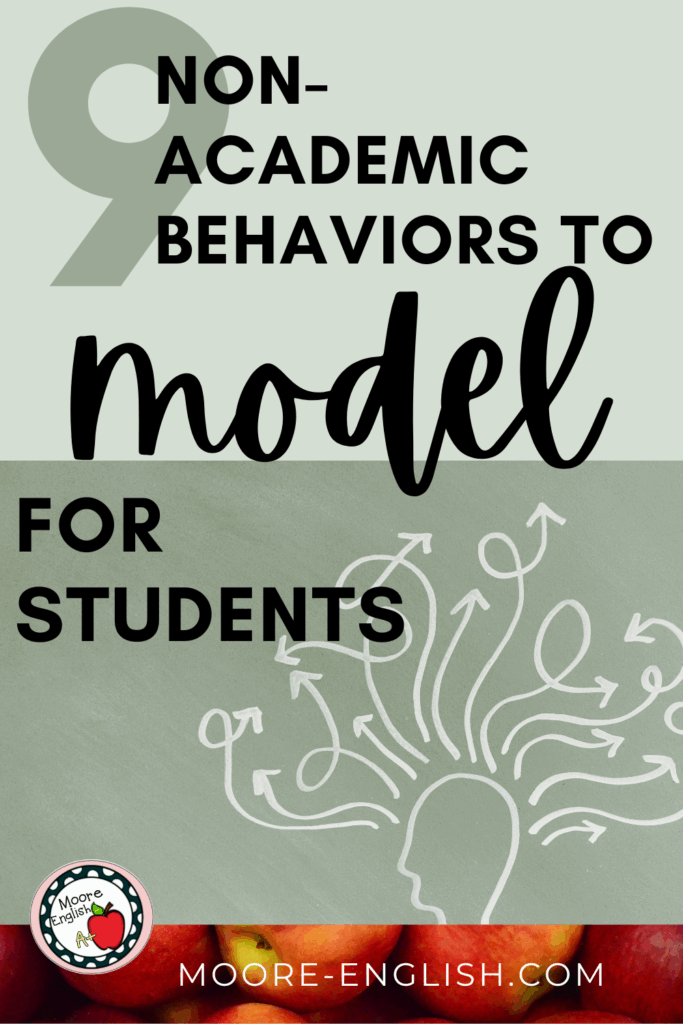
With this in mind, I wanted to share 9 non-academic behaviors teachers can model everyday.

This post may contain affiliate links. Please read the Terms of Use.
Start Simple
Classroom management is challenging because it’s ongoing and requires teachers to constantly take in a tremendous amount of “data,” filter it quickly and appropriately, and respond consistently. With this in mind, start modeling non-academic behaviors with the simplest steps. These are probably things you’re automatically doing, but thinking about modeling consciously makes you more likely to model more consistently.
- First, show students that you are happy to be at school. Modeling joy is one way to engage students and show them that you take learning seriously. Especially at the high school level, school is not often viewed as “cool,” and modeling joy is one way to work against that. Even if you would rather be in bed, this is one of those times when you just have to fake it. I promise the buy-in from students is worth it!
- Similarly, it’s important to model a positive attitude about learning. Even when there is a lesson that I dislike or think is particularly difficult, it’s important to continually emphasize that all students are capable and all learning is valuable. Even if you’re not a fan of math (and I’m not), it’s helpful to stay positive about learning math. Instead of saying “Math is the worst,” try “Math is tough for me, too, but Mrs. Smith is really helpful” or “What are some questions we can ask Mrs. Smith so we can improve?” It’s amazing how this kind of positivity will translate across content areas.
- Finally, good manners are one of the easiest skills to model at school. Simply modeling good manners communicates to students the seriousness of learning and formalizes the process. This is a tiny way to “raise the stakes.” Modeling gratitude goes hand-in-hand with modeling good manners. Let students hear you say “thank you” loudly and often. When students share with one another (or with you) or when they give you a gift, it’s so easy to respond with a thank you note, and that can go a long way in modeling non-academic behaviors.
Leveling Up
As you begin to consciously practice modeling non-academic behaviors, these are some more complex but equally worthwhile behaviors.
Over the years, one thing that has gotten easier has been admitting being wrong and asking for forgiveness. As a new teacher, it was nearly impossible for me to do either of these things because I was afraid students would think I was weak.
However, if you can admit when you are wrong and can ask for forgiveness, then you actually appear stronger and more mature.
As a bonus, when you admit that you are wrong, you can model for students how to correct a mistake. Additionally, modeling asking for forgiveness helps students “hear” what that should or could sound like. Similarly, teachers can model offering forgiveness in a gracious manner.
Modeling Problem-Solving Behaviors
Life is full of plenty of speed bumps, wounds, obstacles, challenges, and everything in between. How we work through difficulties affects our success, relationships, and learning. These are the non-academic behaviors that can be the most difficult (but worthwhile) to model.
- For me, modeling emotional regulation is tough. I am not always patient with myself when I make a mistake. However, it kills me when a student makes a mistake and calls themselves “stupid,” so I’m working hard to model more appropriate responses. I try to say, “Darn, I made a mistake. How can I fix it?”
- Better yet, I’m working on modeling self-talk to work through struggles. Especially when I’m modeling a skill, I try to show students how to guide yourself over and through the difficulties. In ELA, this is especially important when modeling the research process. In my experience, students are sometimes too quick to give up on a research question, and modeling self-talk can help show students how to proceed when your first search doesn’t turn up the results you’d like.
- Similarly, I am an advocate of modeling self-efficacy. When students have high levels of self-efficacy, they are better problem solvers. Clear classroom procedures and routines are an essential part of facilitating student self-efficacy. Read about more strategies for promoting self-efficacy!
- Finally, modeling metacognition is key in helping students understand the value of reflection. Reflective students are better equipped to identify future difficulties, errors, and opportunities for growth. Check out these 7 ways to incorporate metacognition in your classroom!