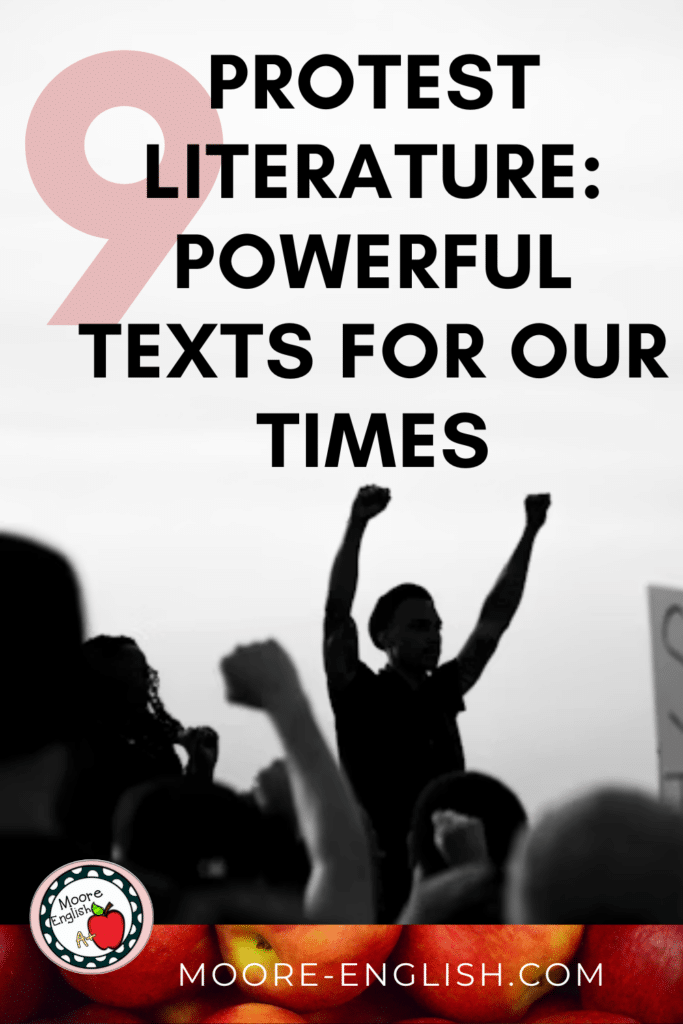
Protest literature has a long history in the United States: pamphlets, chants, rallying cries, treaties, manifestos, and folk songs. I recently heard an All Things Considered segment covering a brass band that is “part of the sound of resistance in Minneapolis.”
In education, I am outspoken. At the same time, I don’t think I have spoken out often enough.
For that reason, I wanted to spotlight protest literature this week. If you, like me, have a hard time finding the words to speak frankly about current injustices, then these pieces may have the words you need.
For me, it’s the end of Audre Lorde’s “Litany for Survival” that keeps playing over in my mind:
….when we are silent
we are still afraid
So it is better to speak
remembering
we we never meant to survive.

This post may contain affiliate links. Please read the Terms of Use.
Teaching is Political
First, it’s important to recognize that the job of a teacher is not to radicalize students.
That being said, think about this, in English class, teachers help students learn
- to evaluate and assess information;
- to identify and avoid fallacious reasoning;
- to organize and communicate their thoughts;
- to develop and craft effective and logical arguments.
Those are all skills that our students will use to build the future. Future building is inherently political.
It’s a cliche, but you often hear that children are always watching. They are learning what kind of future they want by watching us. They see how we respond to injustice, inequality, and ignorance. What do we want them to see?
In this case, protest literature provides teachers with an opportunity to show students what thoughtful action looks like. Half of growing up is learning that actions have consequences and, as a corollary, that inaction has consequences.
Essays and Speeches
When I think of American protest literature, “Civil Disobedience” by Henry David Thoreau instantly comes to mind. Whether our students know it or not, they have read about and, perhaps, witnessed civil disobedience. Understanding the philosophy of nonviolent resistance is a key first step in deciding how to use your voice. Read it here.
In addition, I also think about protest literature from the American Revolution. Common Sense is so closely tied to this era that Angelica Schuyler raps about it in Hamilton. Since students have often read Common Sense in a history class, I usually offer “The Crisis” by Thomas Paine and “Speech to the Virginia Convention” by Patrick Henry. These are such seminal American texts that it’s almost hard to remember that they are, themselves, protest literature. All of my favorite texts from the American Enlightenment are right here!
However, the piece of protest literature I have taught the most often is “Credo” by Neil Gaiman. Written after the Charlie Hebdo terrorist bombings, this essay first appeared in New Statesmen in 2015, but its message endures. This may not be a traditional piece of protest literature, but it encourages readers to think about their actions (and in action) and to affirm their beliefs. Watch Gaiman perform the piece here.
Poetry
For me, some kinds of poetry almost feel like protest. There’s something about experimental styles, enjambed lines, and metrical irregularities that occasionally feel like literary resistance. These poems capture that spirit.
In “For the Consideration of Poets,” poet Haki R. Madhubuti conceives of poetry as protest literature. The opening question “where is the poetry of resistance?” asks readers to consider the injustice of silence and compliance. In putting together a unit about protest literature, this is where I would begin. Ask the question at the start of the unit and then read texts that answer the question. Read the poem here.
As I mentioned earlier, “A Litany for Survival” by Audre Lorde has really been on my mind lately. In this political climate, the idea that survival can be an act of resistance resonates. Read it here.
In “The Sign in My Father’s Hands” by Martin Espada, the resistance is a more traditional protest. The speaker’s innocence is part of what makes this poem remarkable. It’s worth noting that the injustices of 1964, when the poem takes place, are not so different from contemporary injustices. Read the poem here.
Like Espada’s poem, “Us vs Them” by David Tomas Martinez includes an innocent narrator. Starting during the Cold War, the poem follows the speaker as they age and begin to recognize hard truths about the world and the American Dream. While I usually teach this poem alongside The Great Gatsby, it fits as a piece of protest literature. It’s not clear that resistance was Martinez’s goal, but this is certainly a poem that encourages readers to reflect on their beliefs and their part in perpetuating or challenging the status quo. Read the poem here.
Finally, the protest poem I have taught most often is “When I heard the learn’d astronomer” by Walt Whitman. Of the poems here, this one is the quietest. At first glance, the protest is so mild that it seems a small condemnation, but Whitman’s speaker makes a difficult choice: he stands up and leaves a place and a practice to which he objects. It’s a peaceful action to be sure, but those small steps are often the most difficult. Resistance is a learned behavior; for me at least, it doesn’t come naturally, so this is one way to begin. Read the poem here.
Most of these texts are included in the Protest Literature Bundle.