More and more, it seems data is at the heart of teaching and learning. On one hand, I’m a fan of all the ways data can capture content mastery.
I’ve shared a lot about how I use data to drive instruction:
- 6 Steps to Analyze Test Data
- Are You Making These Mistakes in Data Analysis?
- How to Facilitate Student-Centered, Data-Driven Conversations
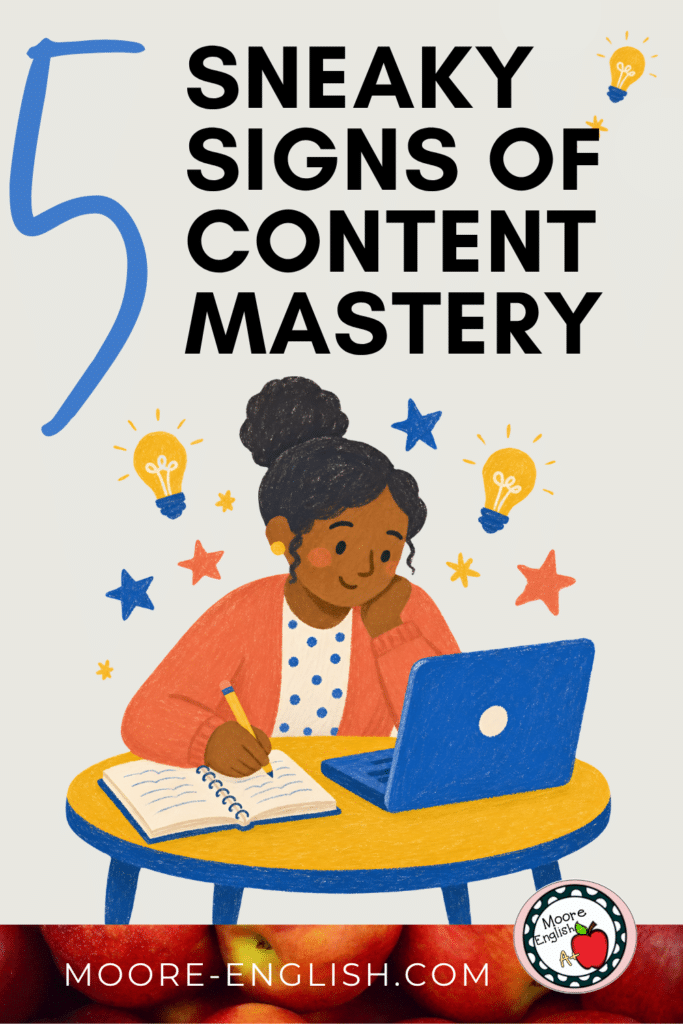
However, crunching the numbers is not the only indication that your students are growing. These are subtle, sneaky, often overlooked signs that your lesson plan actually worked!

This post may contain affiliate links. Please read the Terms of Use.
Content Mastery in Action
There are many myths in education. In particular, there’s the idea that learning should be an easy, seamless, relaxed ride.
In fact, learning is more powerful when students have to work. The process of learning, which might not be dazzling and captivating, is as important as any skill. Sometimes learning is grueling, tiring, messy work; it’s not always linear either!
For this reason, productive struggle is one subtle sign that students are moving toward content mastery!
A lot of teaching and learning happens in the margins, and the same is true of productive struggle. Evidence of productive struggle is in essay revisions, worked problems, and annotations.
When students have to work toward or for an answer, they begin to internalize the process. The emotion of struggle also makes their learning “stick” more powerfully in their minds. The “stickier” the learning process, the more likely students are to move information from short to long-term memory.
In English class, some tools are designed to generate and capture productive struggle:
- Inquiry-based Parallelism Game
- Silent (but productive) Discussions
- 10 poems with challenging text structures
- Free test correction and revision template
Student vocabulary is another sign of content mastery in action. As students wrestles with new skills, content, and processes, they begin to internalize vocabulary. When students start using domain-specific vocabulary, you know they are advancing toward content mastery. Building domain-specific vocabulary is slow business, but the more intently and meaningfully students engage with vocabulary, the more it merges with their personal dictionaries. Use is what helps students iron out those neural pathways that signal content mastery.
These are my favorite vocabulary tools for high school English:
Student Self-Efficacy as Content Mastery
I am a classroom roamer. When students have independent work time, I am constantly on the move checking in and providing feedback. At the beginning of the unit, this can be especially important. My proximity also helps with classroom management and allows me to check in with special needs students.
However, I sometimes I have remind myself to step back and wait. Students can’t reach productive struggle if I’m always there to catch them.
In fact, your students no longer needing you is the best, clearest sign that they are at content mastery.
For me, this is one of the most rewarding and most bittersweet parts of teaching.
You can tell your lesson plan has worked when students turn to one another rather than turning to you. Students capably (and accurately) helping one another is another sign of content mastery. I see this the most during the writing process when students can provide helpful, constructive feedback to their peers. (These peer feedback tickets are how I help get the ball rolling.)
Similarly, when students use their resources, you know they have reached a high level of self-efficacy and content mastery. Over the years, I’ve continually worked to train myself to answer student questions with a resource. Need a pencil? Check the May I Borrow Shelf. Want your Absent Work? Visit the Daily Agenda. Looking for a definition? Check the notes.
I don’t always get it right, but each time I reply with a resource, I help students build their capacity for self-efficacy. Self-efficacy is also key to productive struggle: when students know you believe in them, they are suddenly far more willing to dive in to difficult content. They want your support and faith but don’t always need your hovering. (Or at least that’s what I tell myself when I find myself being too available.)